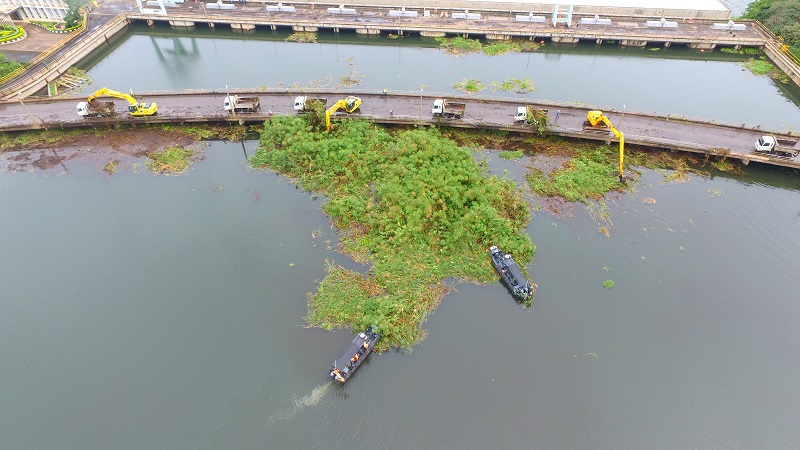
Just days after a floating island interrupted power generation at Jinja’s Nalubaale Hydro Power Dam (180MW) and Kiira Hydro Power Dam (200MW), last night, a second floating island made a landfall.
This is as engineers were finalising clean-up efforts from the first island impact.
The second island broke off from another bigger chunk of landmass that was headed for the dams, but engineers had successfully shoved it off to a nearby pier, pending and dredging and excavation operation the next day (today).
“During the President’s visit yesterday, the second floating island was pushed towards Jinja Pier to be removed. However, given the adverse weather conditions caused by the heavy and windy rains last night and this morning, a part of the island broke off and floated towards Nalubaale dam,” tweeted Eskom Uganda Limited.
It is now feared that the remaining floating island is also on its way to the two dams and could destabilise generation at the two dams, slowing down output at the two dams which are interconnected. Clean-up efforts, at the 2 dams could also partially impact generation at the nearby Bujagali Dam (250 MW) located 8 km downstream, in the northwest of the Nalubaale/Kiira complex.
Already, Uganda Electricity Transmission Company Limited (UETCL) which buys power from Eskom and evacuates it to Umeme for onward distribution, has announced on Twitter that is effecting what it called “emergency load shedding due to further deterioration of plant capabilities at Bujagali, Kiira and Eskom.”
It said most cooling systems at the two dams are out for cleaning.
On its part, Eskom in a tweet said that, its engineers are on ground to “ensure that the floating island is removed.”
During the President's visit yesterday, the 2nd floating island was pushed towards Jinja Pier to be removed. However, given the adverse weather conditions caused by the heavy & windy rains last night & this morning, a part of the island broke off & floated towards Nalubaale dam. pic.twitter.com/pj0d5gLiIk
— Eskom Uganda Limited (@Eskomug) April 20, 2020
We tried to reach Ms. Thozama Gangi, the Eskom Managing Director at Eskom to understand how her company’s generation capacity has been affected but the floating islands but she had not responded to our questions by the time of filing this story.
Another source at Eskom who preferred anonymity, told us that although the weeds have not damaged any power generating equipment, the teams are stretched as they have to alternate between removing the strainers for cleaning and returning them. The weeds are also reportedly tripping off the cooling systems that have to be restarted. As a result, the entire Nalubaale HPP has been switched off and all generation diverted to Kiira HPP which is producing 120 MW at peak time.
 Letters to My Younger Self: Winnie Nakimuli—"You Are Worthy Simply Because You Exist"
BUjagali and Isimba, according to the source, are both producing at full capacity.
A well well-placed source at Umeme, has told this reporter that the shut-down of Nalubaale, has resulted in the power distributor getting 100MW less from UETCL and is, as a result planning a load shedding regime that could last for up to 2 weeks.
“Yes it is true, we are getting less power and right now we are working on a load shedding schedule for about 2 weeks. It is being agreed on with stakeholders and the regulator, as I speak,” said the source.
@ERA_Uganda @UmemeLtd @UegclOfficial @ntvuganda @nbstv @ubctvuganda @bukeddetv we are effecting emergency load shedding due to further deterioration of plant capabilities at Bujagali, Kiira and Eskom. Most cooling systems are out for cleaning. Inconveniences are regrettable.
— UETCL (@uetcl) April 20, 2020
The source however said that Umeme is working on a load shedding schedule that will prioritise all the critical sectors and institutions, especially those involved in the Covid-19 fight.
Although Uganda generates more power than it needs- 1252MW versus a peak demand of 723.76 MW as of 31st December 2019, leaving a surplus of roughly 529 MW of surplus power supply- most of this surplus cannot be relied on during this critical time because of limited transmission capacity. As a result, most of the power from the new dams cannot get to where it is needed, thus making the Nalubaale/Kiira dams a critical source of power.
📽Works continue….! A new island moved towards Nalubaale dam last night and the joint team is currently clearing it. @MAAIF_Uganda has extended one more excavator to support the efforts.#STAYSAFEUG @Eskomug @UegclOfficial @MoWT_Uganda pic.twitter.com/2E61cBshjh
— UNRA_UGANDA (@UNRA_UG) April 20, 2020
Last year, UETCL reported that up to 15 transmission line projects were being delayed by compensations of up to 42,000 projected persons. According to UETCL’s Edward Muteesa, the Principal Projects Officer 80 per cent of delays in energy projects, are due to delays in compensation to project affected persons.