
Ugandan nationals are for the first time in the country`s history getting National Identification Cards. Although the exercise has begun in the capital Kampala, it will soon cover the entire country. The National ID`s come at a time when Uganda is teeming with a near exploding population come 2020 when the population is bound to reach 50 million people. Population explosion aside, Uganda has been hosting too many refuges some of who were born and raised in Uganda. In this interview, The CEO`s Patrick Kagenda talks to the Project Manager Mr. Marcellino Bwesigye.
Who is the true Ugandan citizen who qualifies for the National ID. But before that, what is citizenship?
Citizenship is a term referring to a legal status acquired by an individual within a state to which that individual offers allegiance and which confers certain rights and responsibilities on that person. Citizenship is the legal belonging to a given state after meeting certain named criteria.
For the case of Uganda citizenship, such criteria may require one to belong to an indigenous community or tribe, ancestry of the parents of the applicant and period of residence in the country. However Article 9, of the 1995 constitution inherits the Uganda citizenship status of all those persons who were citizens of Uganda by 1995.
How are you going to deal with the challenge of communities that are resident in Uganda but are not Ugandan?
Registration officers should generally note that there are so many non citizens resident in Uganda .Many of them reside within Kampala while others are scattered all over the country. Ugandan indigenous communities are mentioned as part of our third schedule of the 1995 Constitution. Any claimants to citizenship under these provisions ought to provide documentary evidence of a Citizenship when seeking Registration.
How about the cross border communities aren’t they a threat to the project?
Long before colonialism, many African communities exercised social cultural citizenships without legally defined borders. However, with existing borders legally defined and demarcated,most of these borders were and are still artificial both in practice and in perception of the border people. These are people with the same social cultural and ethnic origins, relatives living on either side of the border.
They include Basamia, Acholi, Banyarwanda, Madi, Bakonzo, Bamba, Pokot, Alur and so on. The registration officers at the border communities will be trained to be conscious of these facts and exercise extra care to ensure that only Ugandan citizens are registered and Identified. Documents of applicants will be thoroughly scrutinized and interviews conducted to ascertain their place of birth and origin.
That said, what are the main features of the National ID?
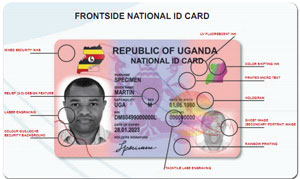
We have the National Identification Number (NIN) which is a unique number allocated to a person upon their application for registration as a citizen of Uganda being approved.
This number is printed on the front face of the National Identity Card. It is unique to an individual and every citizen will be identified with the same number throughout their life once the project has fully rolled out.
The NIN is the ultimate proof of your identity and it will be used to track personal information in places like banks, hospitals, law enforcement agencies, tax bodies and others.
The NIN will be part and parcel of an individual’s life in Uganda and beyond. The National document will be issued to only citizens of Uganda of or above the age of 18 years while the law allows issuing it to those below 18 years in some circumstances.

The holder is required to carry it as a means of confirming their identity. The identification system has bio-metric features such as the fingerprint to confirm the identity of the card holder. This card provides the means for fingerprint verification only via external systems like verification devices.
Why should a person apply to be registered in order to be issued with the National ID?
The law requires that all Ugandans must be registered and issued with National Identification Numbers and those who are 18 or above shall be issued with national Identity Cards. Besides, there are a number of benefits to it that include:
I-To be able to prove your Uganda citizenship
II-To be able to assert your rights and status as a citizen
Related
 Beyond the Low-Hanging Fruit: The Grit, Capital, and Vision Required to Industrialise Rural Uganda
III-To prove your Identity in the quest for National Services
IV-To be eligible for employment both in the private and public sectors in Uganda
V- To be used to vote during National elections
VI-It is mandatory under (Sect 27 Cap 66).
Where are people supposed to apply for the National ID from?
The Minister of Internal Affairs will designate places throughout the country as places for registration and ID cards issuance. However we are now issuing ID cards in Kampala City. Details of exact locations have been mentioned in the media.
What documentation is required of one to present when they go to applying and be registered for the National ID?
Different categories of citizenship require different documents as evidence to support their application to be registered as citizens of Uganda and subsequently being issued with a National ID. They include the Birth Certificate, Religious Certificate, School leaving Certificates, Child health Card, Notification of birth, Letter of administrative officer, Parish/Sub county chief, Statutory Declarations, and an LC Letter.
What would one do if they lost their National ID?
Any person who loses/damages their national ID must report to the nearest police station. After reporting the loss, that person shall then make an application for replacement of the lost ID card to the NRS. The following documents are required if a person is applying for a replacement of the ID card:
I-Police abstract/ report only where the ID card is lost or the Card is not recognizable.
II- ID Card or photocopy if available
III-If the ID number is not available, the person must report personally for fingerprint scanning. New bio-metrics must be captured if the registration date is longer than six (6) months back. This also ensures that bio-metric data is regularly updated.
IV- A payment receipt for the lost ID card.
Can one use the National ID as a travel document within the EAC region?
Yes for the time being, our National Identity Card may be used as a travel document. It has a machine readable zone in line with set ICAO (International Civil Aviation Organization) recommendations and hence such an option may be available in the future when the modalities for doing so have been worked out.
What is the cost involved for one to get a National ID?
The National Identity Card is issued free of charge for the first time but a fee shall be levied upon replacement. Upon replacement after expiry, change of particulars, loss or damage of the National ID card, you may be required to pay a fee.