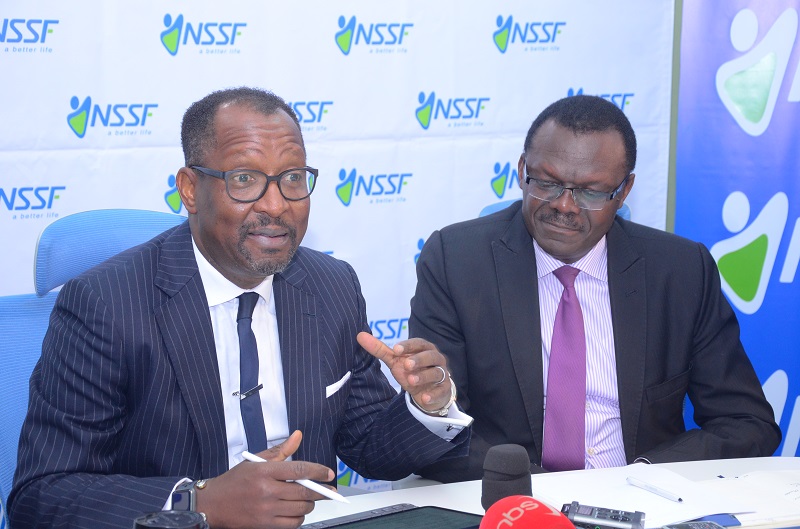
Despite a 17 percent growth in revenues, the National Social Security Fund (NSSF) has warned, it is unlikely to pay members a double-digit interest rate due to the impact on the COVID-19 pandemic on its operations.
In a virtual media conference NSSF Managing Director Richard Byarugaba said that the economic downturn in Uganda and East Africa resulting from the impact of the pandemic did affect the Fund’s operations and performance in the last 2 quarters of Financial Year 2019/2020.
“The economy contracted by 3.2% in the second quarter of 2020 and economic growth projections dropped to 3% to 4.0% compared to 5.2% in the previous Financial Year. The Fund’s operations were also affected. The stock market gains in the first 2 quarters of the year were wiped out by the end of the year,” Byarugaba said.
“In addition, we were also affected by the Uganda currency movement in relation to other major currencies; and the directive by the Central Bank to hold back dividend payments by commercial banks. All combined to affect the Fund’s performance last Financial Year,” he said.
“Given the operating environment we faced, we may not be in a position to pay a double-digit interest rate on members’ savings for the Financial Year 2019/2020,” Byarugaba added.
The Minister of Finance, Planning and Economic Development Matia Kasaija will declare the annual interest rate on Monday, September 28, 2020, at the Fund’s Annual Members Meeting. This is in line with Section 35 (2) of the NSSF Act.
Last year, the Fund paid 11% interest rate, and 15% the previous year. The Fund last paid a single-digit interest rate in 9 years ago in Financial Year 2010/2011.
Despite the anticipated low interest rate, Byarugaba reassured contributors that whatever rate the Minister declares, it will still be very competitive, above the 10-year average rate of inflation.
“We will also keep the promise made to our members when we launched our 10-year Strategic Plan; which is to pay at least the 10-year average rate of inflation plus 2 percentage points,” he said, adding that the 10-year average rate of inflation has been 6.2%

“Whatever happens, I can assure our members, it will be above 8.2%,” he said.
NSSF 2019/2020 Performance Highlights
 Letters to My Younger Self: Winnie Nakimuli—"You Are Worthy Simply Because You Exist"
Byarugaba told the media that the Fund’s Assets under Management increased by 17% from UGX 11.3 trillion to UGX 13.38 Trillion as at June 30, 2020, mainly driven by increased contributions and interest income. Total Revenue also increased by 17% from UGX 1.25 trillion in 2018/19 to UGX 1.47 trillion as at June 30, 2020, driven by growth in interest income as a result of exposure to high yielding fixed income investments and rental income.
He said that due to COvid-19 hardships, member contributions increased by only 5% from UGX 1.22 trillion to UGX 1.28 trillion.
“The marginal growth is attributed to the amnesty we offered to business that were affected by COVID-19 pandemic. To put into context, the Fund deferred a total of about UGX 22 billion,” he said adding that this was the first time ever in 10 years the total contributions were growing by single digit.
Money paid in benefits to qualifying members increased by 8% from UGX 450 billion in 2018/2019 to UGX 486 billion in 2019/20. The Fund also managed to keep its cost of administration down at at 1.20%, an improvement from 1.28% in 2018/2019. Cost to income ratio also improved by 7% from 13.02% to 12.05%.
NSSF is resilient and will bounce back
Due to COVID-19 Standard Operating Procedures (SOPs), the Fund will hold a virtual meeting. NSSF members will participate online and via live television. To participate, members can register via the Fund’s USSD *254# of online at www.nssfug.org/amm2020
He also reassured members that the Fund was resilient and will in the medium to long term shake off the effects of COVID-19.
“Our resilience is evidenced by the fact that in spite of the economic downturn and the effect on our operations, the Fund’s assets under management registered a 17% growth from UGX 11.3 trillion to UGX 13.38 trillion. Our upward trajectory towards achieving at asset base of UGX 20 trillion by 2025 is not in doubt,” he reassured members.
Byarugaba also said that at a time when businesses have barely grown, when many businesses across the globe are focused on survival rather than growth; consolidation rather than expansion, the Fund has withstood the shocks.
“We have delicately balanced the risk-return equation to ensure that we add value to our members’ savings,” he added.