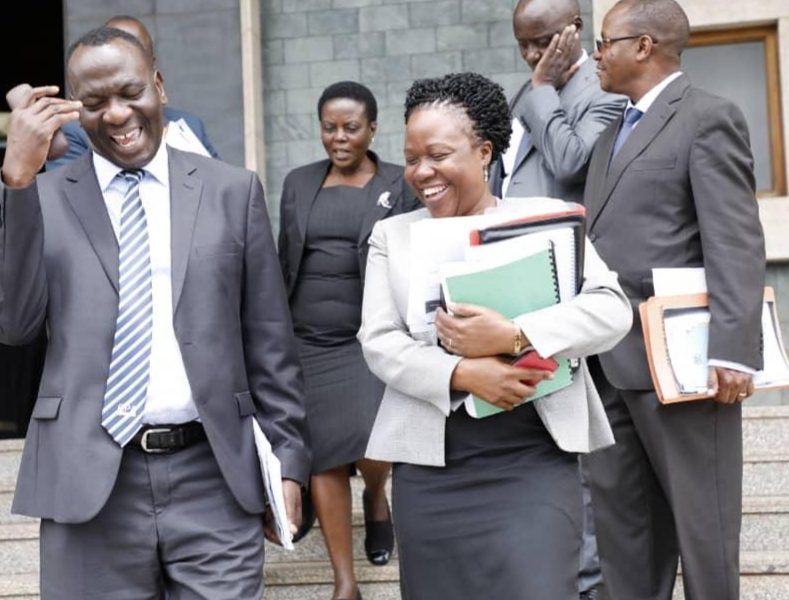
The idiom “throwing good money after bad money” refers to spending more money on something problematic that one has already spent money on, in the (presumably futile) hopes of fixing it or recouping one’s original investment.
Unfortunately, this was the decision the Bank of Uganda Governor had to make on Tuesday, August 27th at the behest of Margaret Kasule the central bank’s legal counsel, with help from J.B Byamugisha Advocates, their external lawyers.
At a meeting called by the Governor in his office, on Tuesday, Mutebile was faced with two decisions: accept the ruling, pay the costs and take the smack in the face or appeal the ruling, albeit the flimsy grounds, save face and postpone the costs to a later date, even if they will be higher- after all in either case, it is the taxpayer to bear the costs.
Unfortunately, Mutebile took the latter, thus the hastily made announcement on Twitter, by BoU Director of Communications that BoU would appeal and pursue the matter to its logical conclusion.
Why do we believe, BoU has a bad case?
On 30th June 2017 Crane Bank Limited [In Receivership] filed Civil Suit No. 493 of 2017 against the Sudhir and Meera Applicants seeking a payment of an equivalent of USD110 million as compensation for breach of fiduciary duty.
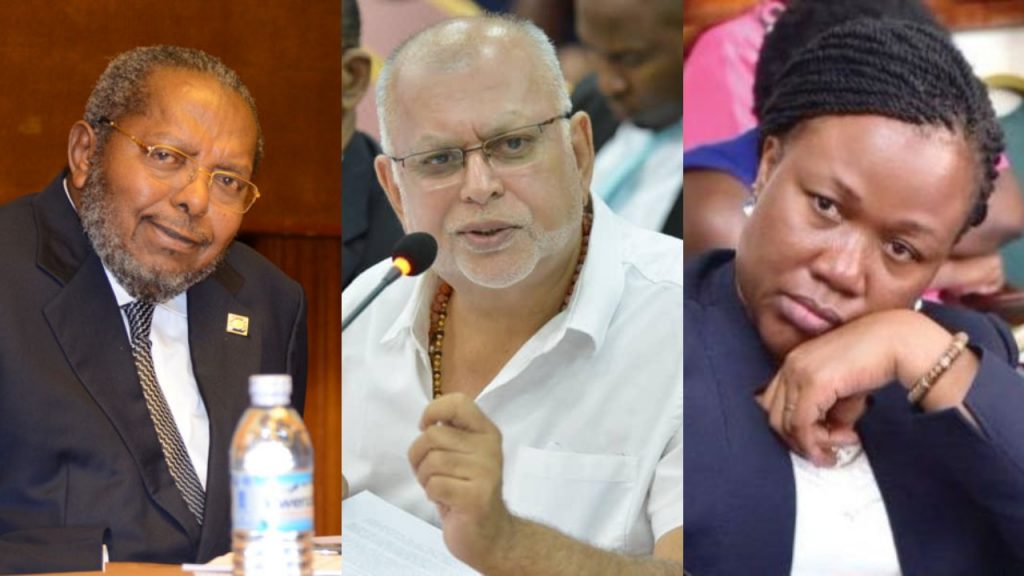
Crane Bank (in receivership) also sued Meera Investments for 48 freehold land titles comprising its former countrywide branch network that it claimed were illegally transferred from Crane Bank to Meera Investments.
Sudhir, through KAA Advocates applied to court to dismiss the suit saying that Crane Bank (in receivership) has no locus to bring the suit to court, since the Financial Institutions Act (2004) did not permit a receiver to sue or be sued. Sudhir’s lawyers Kampala Associated Advocates also said that on account of being a foreign owned institution, Crane Bank could not own freehold land and therefore couldn’t sue to own, that which it legally cannot own.
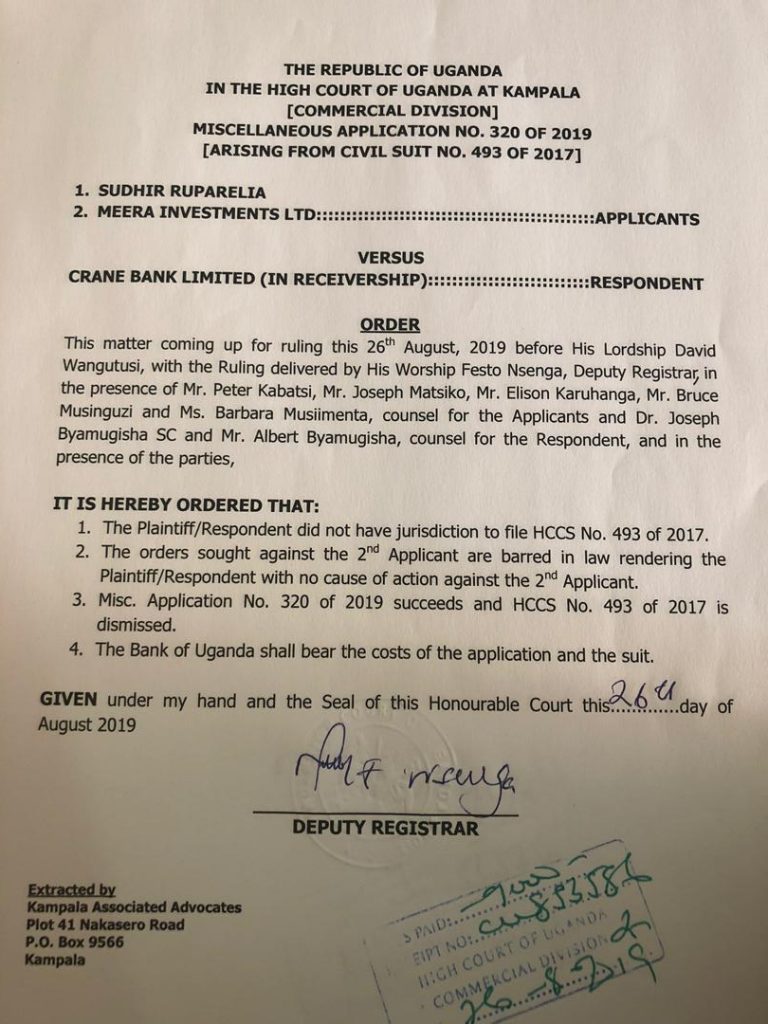
In his ruling, Hon Justice David Wangutusi, did not mince his words- he said BoU “did not have jurisdiction to file HCCS No. 493 of 2017” and that the orders sought against Meera are “barred in law, rendering” BoU with no “cause of Action” against Meera.
Giving his reasons on why he thought BoU did not have a locus standi, Wangutusi, based his ruling on The Financial Institutions Act which clearly lays out the role of a receiver.
“In my view if it (FIA 2004) had wanted the Receiver who had only 12 months on stage to sue, it would have expressly provided for it. It is not that the Act does not provide for instances of going to Court, having provided for others and left out the Receiver speak loud and clear of the intention of the legislature.
It is not upon Court now to imagine and say “the legislature forgot this we should insert it for them.”
It is then clear that when the Receiver filed this suit, it was not clothed with authority. It had no power to do so and Court cannot impute an intention foreign to the legislature.”
 Debt, Deals & Disputes: Inside the High-Stakes Legacy-Altering Legal Battles of Ugandan Billionaires — Bitature, Basajjabalaba and Dei's Magoola
“The end result is that once Crane Bank was put under Statutory Management, its Board of Directors was suspended. If there was to be any suit, it would be brought by the Central Bank as the Statutory manager under section 89(2)(e) or by the Liquidator with approval of the Central Bank under section 100(1)(a) of the Financial Institutions Act.
These two were empowered to initiate and defend court action by the Financial Institution Act which interestingly left out the Receiver. The Legislature did not want any court action against the Receiver…… It follows that the Respondent under Receivership lacked locus standi. Without locus standi its attempt at filing a suit was null ab initio (to be treated as invalid from the outset).”
Following the dismissal, he ruled that “The Bank of Uganda shall bear the costs of the application and the suit”
How much is at stake?
According to several lawyers CEO East Africa talked to in calculating the costs, usually at the High Court Level- usually the judge allows up to about 2% of the decretal amount or amount in dispute. So in this case since the Central Bank was suing Sudhir for an equivalent of $110 million, the least amount that Sudhir would sue for would be USD2.2 million (UGX8.1 billion)- although this can go up to 5% or USD5.5 million (UGX20.3 billion) if the lawyers make a good case.

In the case of Meera, it would have to be 2%-5% of the UGX400bn estimated value of the 48 freehold titles in contention, which would come to anywhere between UGX8 billion to UGX20 billion.
In Shilling terms- Sudhir would be entitled to taxed costs amounting up to UGX40.6 billion, before the appeal.
But now that there is a decision to appeal, should BoU lose, they stand to pay up to 10% of the decretal sum- in this case USD11.1 million (UGX41 billion) to Sudhir and UGX40 billion to Meera Investments- altogether in excess of UGX81 billion.
It could even be more, given that the judges are also allowed discretion. Some lawyers and analysts have put the some to anywhere between UGX81 billion to UGX110 billion.
But maybe Bank of Uganda does not care, at this stage because it is not their money- it is the taxpayer’s money, who incidentally includes Dr. Sudhir Ruparelia, one of the country’s biggest tax payers.
Moreso, the decision to appeal could be “postponement of embarrassment” given that both the Governor and Deputy Governor’s contracts are about to expire and may not be renewed. An appeal therefore means that the cost and embarrassment of the loss will be in another governor’s regime.