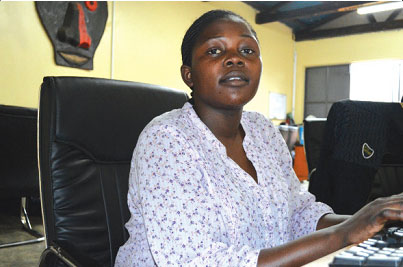
Best Aiyorwoth, 21, founded Girls Power Micro-lending Organization (GIPOMO) in 2011 to purposely promote girl child education in Nebbi District, in North Western Uganda. Since inception, she has been struggling to sustain the organization using the meager savings from her little salary. However, her winning the 2013 Anzisha prize worth US$ 25,000 (Ushs 65 million) in August, 2013 has completely changed not only the fortunes of the little girl, but also many more girls in the larger northern Uganda.
The Anzisha Prize is the premier award for African entrepreneurs aged between 15 and 22 who have developed and implemented innovative businesses or community projects. The CEO Magazine’s Silvia Nyambura caught up with little known Best Aiyorwoth on how she started the organization and scooped the 2013 Anzisha prize. Excerpts

What is GIPOMO and what inspired you to start it?
GIPOMO stands for Girls Power Micro lending Organization, a business I began in 2011 and it is based in Nebbi district, in Northern Western Uganda. The organization supports girl child education through economically empowering the mothers. Basically, we lend money to the mothers to start businesses or boost existing ones such that they are able to provide for their girls’ educational needs. I always wanted to help girls because my siblings and I did not have the chance to have a higher level of education since my mother passed on when we were young. This is what inspired me to start my business.
The biggest challenge from the beginning had been raising funds. I came to Kampala in 2009 where I joined a vocational training school for different courses including catering, graphics and web IT. I then joined S7, a skills empowerment center based in Namuwongo, where I got trained in entrepreneurship and graphics. The center had plans to open a restaurant so they trained us in Mexican food and after that I started working at the Mexican restaurant called the Little Donkey in Kampala in 2011.This gave me the advantage of having a reliable income that really helped me to start and fund GIPOMO.
How did you finally get GIPOMO up and running?
I started GIPOMO when I began working at the Mexican Restaurant and my startup capital was Ushs 100,000 which I had saved from my salary. I went to an existing SACCO in Nebbi and asked them to set me up with credible women for my entrepreneurship class project and in turn they gave me 10 women who I gave Ushs 10,000 each. It is amazing what women in the village can do with that kind of money which someone in the city would blow in a minute.
These women started businesses like packing groundnuts, selling firewood, charcoal, second hand clothes and so on. The women were required to pay back the money at an interest rate of 10 percent. So, after six months, I had saved Ushs 300,000 and put it all back into the business. S7 became very interested in what I was doing and they loaned me Ushs 800,000. This went a long way in expanding the business in the village.
What strides have you made so far?
Most of the women I began with have moved from one business to another while some run many businesses. We are currently supporting 45 girls and we meet them once a term and award them for performance. At the same time we have 35 women that have running businesses and who borrow from us regularly. We have 25 existing businesses that have been boosted by this initiative and we also have 150 women who started businesses independent of us, just out of being inspired by what we are doing in anticipation for our help. For these independent business women, we provide training but we don’t fund them because we did not have the resources.
Many people especially in villages don’t want to pay back on the basis that it’s free money from government. As a young girl, how do you ensure they pay back without hustle?
We put our beneficiaries in groups of three for credibility purposes. The collateral is the group of three which means the group members are responsible for each other. If one does not have money to pay back, they help each other pay up.
Related
 Vodacom Tanzania's Philip Besiimire’s Three-Year Scorecard: Growth, Discipline, and Dividends
How did you know about the Anzisha Prize and what do you think made you win?
I got to know about Anzisha Prize through my Mentor from S7 Mr. Gerald Otim. Earlier in February of this year I emerged the overall winner of the Uganda Business Challenge Award, then in March Mr. Otim told us about the Anzisha Prize so I filled the forms. It was a rigorous process going through elimination stages until I got to the semifinals.
The Anzisha Prize needed proof of existence of business and they even came to Uganda to see for themselves what I was doing after which I got into the 12 finalists. I attribute my win to the impact of my business on the community, how scalable the organization is and how well I know my business. It was also impressive for the judges that I had managed to start GIPOMO with very little money and savings from my restaurant job (Ushs100, 000).
How much is GIPOMO worth and how will the Anzisha prize money impact your business?
Before the prize money, GIPOMO was worth approximately Ushs 6 million made out of a starting capital of Ushs 100,000 and salary saved from working in a restaurant. The prize money will help me spread my wings to a larger community outside Nebbi District. Currently, I work with three staff members but this will soon change. I want to have a national reach in about five years as well as expand into agriculture micro lending and economically empower more people.
What is the future of GIPOMO?
The future of GIPOMO is very bright because the Anzisha prize money will give me great mileage. I still work at the Little Donkey and I have been running the business at the same time which was a little hectic but I plan to take a leave from the restaurant for three months to help me set up the organization properly. With such a boost in finances I am capable of doing so much in a very short time with proper planning and management.
What is your advice to budding entrepreneurs?
The biggest problem with young entrepreneurs is that they think about how much money they can make before they make it. I have never taken any salary from my business; since I began every shilling I got from the business, I injected it back into the business. The 10 percent interest I receive I give it to another needy woman, another needy girl child. The way to run and sustain a successful business is to start a business that solves a problem instead of doing businesses because others are doing it.
Identify a need to address in the community and then find solutions for it. People’s life experiences are also a great trigger for good business ideas for example my idea came from the fact that I did not have a chance to have a higher education.Persistence is also very important because things will not always go smooth but you need to keep striving for excellence.